Every year in late May, the eyes of the sporting world are focused on Paris. Everyone talks about championship trophies, epic five-set duels, and red dust. However, if you were to ask an average passerby on the street who Roland Garros was, most would answer without hesitation: “One of the greatest tennis players in history!”
This is probably the single greatest misconception in the entire world of sports.
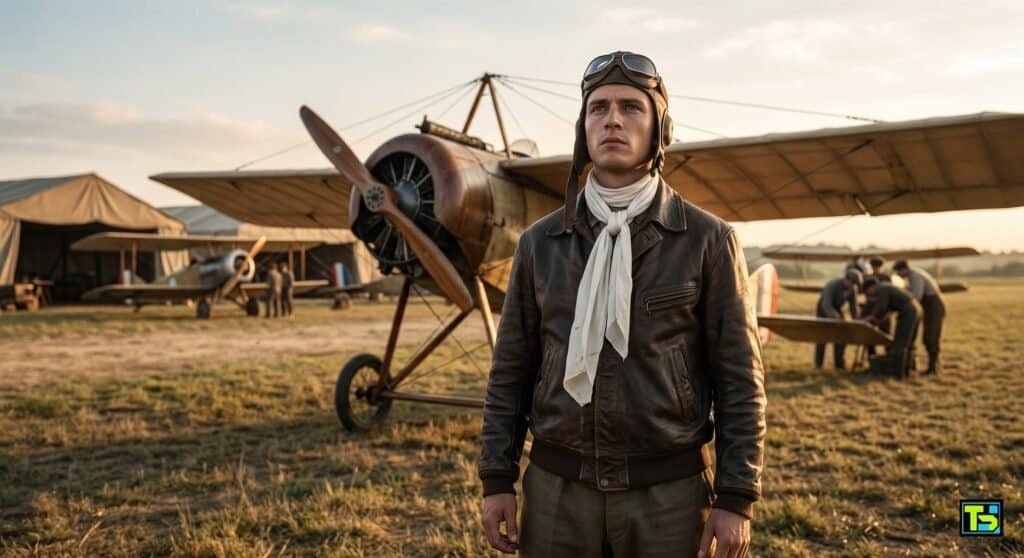
The man after whom the most famous clay-court tournament is named never played a professional tennis match in his life. He was a football player, a rugby player, a passionate cyclist, but above all – a pioneer of aviation, a war hero, and a visionary who changed the course of history.
This is his incredible life story.
The Boy Who Defeated Illness and Discovered a Passion for the Sky
Roland Garros was born in 1888 in Saint-Denis, on the island of Réunion. As a young boy, he faced serious health issues – suffering from severe pneumonia, which prompted his parents to send him to a boarding school in Paris for better climate and specialized care.
To strengthen his body, young Roland devoted himself fanatically to sports. At the age of 17, he won the French cycling championship under the pseudonym “Daniel”, and he actively played football and rugby on a competitive level.
However, his entire life changed forever in August 1909, when he visited one of the world’s very first airshows. Watching the early aircraft models rise into the air, he made a sudden decision that would determine his destiny: “I must fly.”
An Aviation Pioneer and the Historic Flight Across the Mediterranean
Garos immediately bought his first plane (a small Demoiselle monoplane) and taught himself to fly, completely alone, without a single professional lesson! He quickly earned a reputation as an exceptionally brave and technically skilled pilot.
Just four years later, on September 23, 1913, Roland Garros entered the history books forever. He completed the first non-stop flight across the Mediterranean Sea. He took off from Fréjus in the south of France and, after nearly eight hours of flight and covering 730 kilometers, landed safely in Bizerte, Tunisia. When his wheels touched the ground, he had barely five liters of fuel left in his tank. Overnight, Roland Garros became a global national hero and a symbol of bravery across Europe.
The First Fighter Pilot and the Invention That Changed Warfare
When World War I broke out in 1914, Garros immediately volunteered for the French Air Force. At the time, airplanes were used exclusively for reconnaissance, and pilots shot at each other with ordinary revolvers or even threw stones.
Garros wanted more. Together with engineer Raymond Saulnier, he designed a revolutionary invention: a system that allowed a machine gun to be mounted behind the aircraft’s propeller, allowing bullets to pass between the spinning blades without damaging them. They fitted small steel deflector wedges onto the propeller blades to deflect any bullets that might hit them.
With this invention, Roland Garros became the first true fighter pilot in history. Within just two weeks in April 1915, he shot down three German planes, and the French press declared him the first aerial “ace” in history.
Captivity, a Cinematic Escape, and a Tragic End
In mid-April 1915, his luck turned. Due to a sudden engine failure, he was forced to land behind enemy lines. The Germans captured him before he could set fire to his plane and destroy the secret of the machine gun. German engineer Anthony Fokker analyzed Garros’s system and, based on it, developed an even more advanced synchronizer gear, which gave the Germans temporary supremacy in the skies.
Garros spent three long years in German captivity. Yet, his hunger for freedom was stronger than the prison walls. In February 1918, along with fellow pilot Anselme Marchal, he managed to escape from the camp disguised as a German officer.
After a dramatic escape through Germany and the Netherlands, he made it back to France. Despite his failing health, he refused an offer to work in the rear as an instructor. He climbed back into the cockpit.
Unfortunately, fate dictated that he would not see the end of the war. On October 5, 1918, just a month before the armistice was signed and a day before his 30th birthday, Roland Garros was shot down and killed in aerial combat over the Ardennes.
How the Aviator “Conquered” the Tennis Temple
How is it possible then that the most famous tennis complex in the world bears the name of a man who dedicated his life to airplanes?
The answer lies in a loyal college friendship. In 1928, France had to build a new, modern stadium to defend the Davis Cup trophy won by the famous “Four Musketeers.” The president of the Stade Français rugby club, Émile Lesieur, was a close college friend of the late Roland Garros.
Lesieur agreed to provide the land for the stadium’s construction, but under one sole condition: that the new sports complex bear the name of his heroic friend who gave his life for his country.
Thus, a legend was born. Today, when you watch the matches in Paris and see the world’s best tennis players battling on the scorching clay, remember that the name of this temple of tennis celebrates a man who flew freely, defied the laws of physics, and always reached for the skies.
Follow all the matches, fun facts, and analysis from this year’s tournament on our Roland Garos 2026 Ultimate Guide