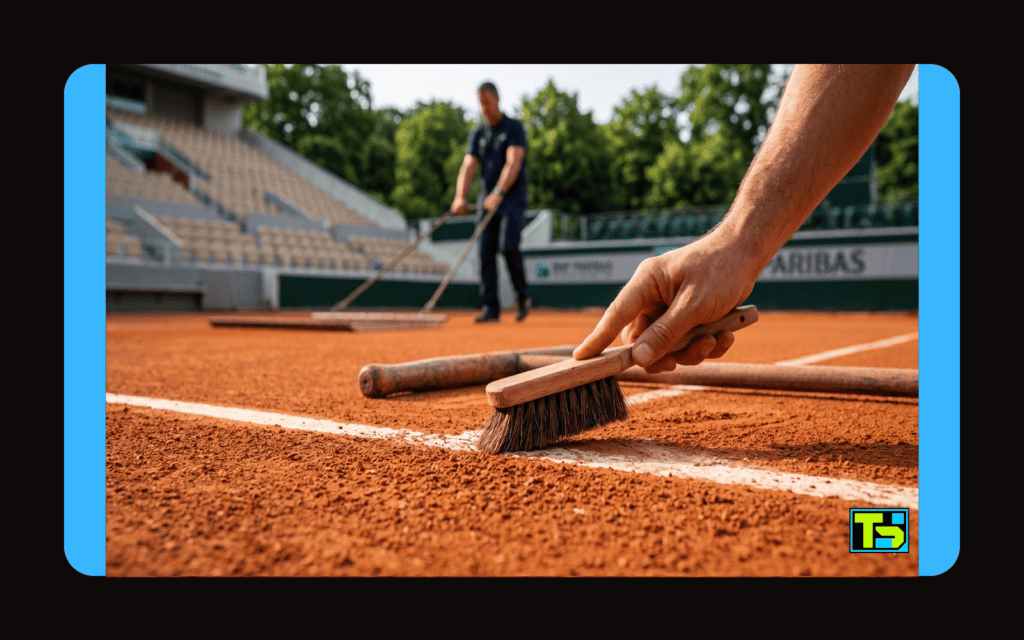
When the world’s best tennis players meet in Paris in late spring, sliding becomes their primary weapon, and the unpredictable bounce of the ball their greatest enemy. Red clay is the signature of the French Open, a surface that favors the most physically resilient and tactically intelligent players.
How many times have you wondered what that famous clay is actually made of?
Although we all call it “earth” or “clay,” the truth is entirely different. The surface on which tennis history is written is not actually soil at all. It is a technological masterpiece composed of five carefully layered tiers, where the red dust itself makes up only a tiny fraction of the overall structure.
In this article, we reveal the secrets of Parisian clay and the meticulous process of its daily maintenance.
Anatomy of the Court: Five Layers of the Parisian Wonder
A court at Roland Garros is approximately 80 cm deep. To obtain a perfect surface that absorbs water rapidly while allowing controlled sliding, court builders use the following five layers:
| Court Layer | Composition & Material | Layer Thickness | Role of the Layer |
|---|---|---|---|
| 1. Surface Layer | Red dust from crushed brick | About 1 to 2 mm | Provides the iconic color, enables sliding, and shows ball marks. |
| 2. Clay Base | Crushed white limestone (limestone sand) | About 7 to 8 cm | The crucial layer compacted to make the court firm, flat, and stable. |
| 3. Middle Layer | Coal clinker (residue from coal combustion) | About 7 to 8 cm | Acts as a filter and barrier that retains moisture but allows excess water to pass. |
| 4. Coarse Layer | Crushed gravel and coarse stones | About 30 cm | Provides structural stability to the court and rapid drainage of water to the bottom. |
| 5. Court Foundation | Drainage pipes and drainage system | At the bottom of the court | Drains all excess water away from the complex after heavy downpours. |
As you can see, the famous red brick is only present in the top layer, which is barely two millimeters thick! To cover one of the main courts (such as Court Philippe-Chatrier), about $1.5 tons of crushed brick is required.
How Is the Clay Maintained During the Tournament?
A perfect court at Roland Garros is no accident – it is the result of the hard work of an army of over 100 professional groundspeople (known as terriers or court maintainers) who look after the surface literally 24 hours a day.
The maintenance process is divided into several phases:
1. Between Matches (Quick Service)
As soon as a match ends (or during the break between sets), a team of workers rushes onto the court to perform three key tasks:
- Cleaning the lines: The lines are swept with special brushes to ensure perfect visibility for both players and referees.
- Leveling (dragging the net): Workers drag heavy jute or metal mats across the clay to smooth out footprints and sliding marks.
- Watering: If the day is sunny and windy, the clay dries out quickly and becomes dusty. A light spraying of water restores its elasticity and prevents the wind from blowing it away.
2. Nighttime Court Care
The real work begins only after the floodlights go out and the last spectator leaves the complex. Overnight, the courts are heavily soaked with water to allow moisture to penetrate deep into the limestone layer. After that, the courts are rolled with heavy rollers to compact the surface, keeping it perfectly firm and level for the next day’s matches.
Why Is Clay the “King’s Surface”?
Playing on clay requires completely different movement and tactics compared to grass or hard courts:
- Slower Bounce: When the ball hits the clay, friction slows it down dramatically (losing up to
40%of its speed). This allows defensive players to reach even the most challenging shots. - Higher Bounce: Due to the texture and compacted limestone, the ball bounces significantly higher after hitting the ground, giving players who use heavy topspin (like Rafael Nadal) a massive advantage.
- Sliding: Tennis players use sliding to stop and change direction. This reduces pressure on their joints and knees but requires perfect balance and timing.
The next time you watch the world’s best players battle in Paris, you will know that beneath their feet is not just ordinary red dirt, but a century-old tradition and superb engineering packed into five magical layers.
Follow all the matches, fun facts, and analysis from this year’s tournament on our Roland Garros 2026 Ultimate Guide