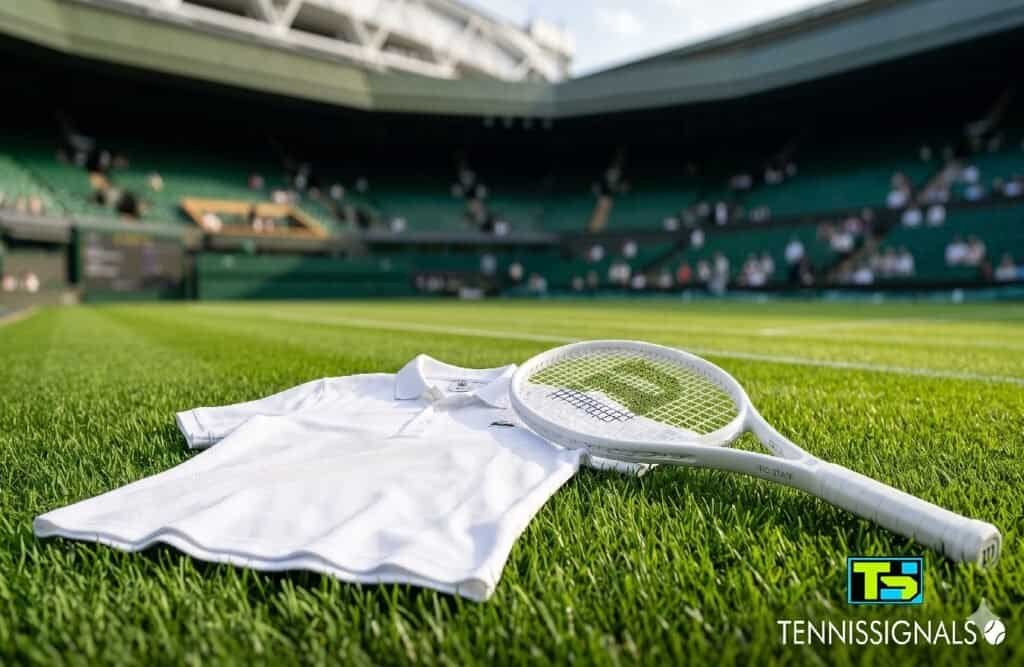
While players at the US Open or Roland Garros compete to wear the most unusual, colorful, and provocative gear, Wimbledon remains an oasis of absolute uniformity. The whiteness that blanks the courts of the All England Club is not just an aesthetic choice—it is one of the strictest sports rules in the world, enforced by a whole army of tournament officials.
But why white, and how has a rule that sounds so old-fashioned managed to survive all the way to 2026?
It All Started Because of… Sweat
The roots of this rule take us back to the 1880s, into the heart of British Victorian society. At that time, tennis was a social event reserved exclusively for the aristocracy and the upper class. Gatherings were an opportunity to socialize, and the game required physical effort, which led to inevitable sweating.
In the strict society of that era, sweat stains on clothing were considered extremely improper and vulgar (especially for women). Since sweat was most noticeable on colored clothing, a practical solution was adopted: all participants must wear white, as “tennis white” hid the signs of exertion best. What began as a 19th-century rule of politeness was officially written into the rulebooks in 1890.
When “Predominantly White” Became “Almost Entirely White”
Interestingly, the rules today are much stricter than they were a few decades ago. In the 1970s and 1980s, players managed to sneak in pastel colors, colorful headbands, and prominent logos. However, in 2014, the organizers decided to crack down on modern trends and issued a decree that leaves no room for interpretation.
Today, the gear must be “almost entirely white.” Only a single border of color around the neckline or sleeves is allowed, and it cannot be wider than exactly one centimeter (10 millimeters). The rule applies to absolutely everything: caps, wristbands, headbands, laces, and even the soles of the shoes!
Throughout history, many have tried to defy this rule, leading to serious controversies:
Equality Above Sponsorship Millions
Why does Wimbledon, despite pressure from major sports brands like Nike and Adidas, refuse to give up this rule? The answer lies in the tournament’s philosophy: at Wimbledon, the player and the tournament are always bigger than the brand.
When they put on white, the lowest-ranked qualifier and a billionaire with 20 Grand Slam titles look exactly the same. The dress code erases differences, eliminates the “circus” of colorful advertisements on the Centre Court, and focuses the crowd’s attention on what truly matters—the pure art of tennis played on the most perfect grass in the world.
Looking for more stories from London, match schedules, and the latest tennis analysis? Return to our Wimbledon 2026 – The Ultimate Guide and stay up to date with every detail of the most prestigious Grand Slam!