Wimbledon is not just the oldest tennis tournament in the world; it is also a logistical phenomenon full of unique rules you won’t find at any other Grand Slam. While other tournaments sell tickets exclusively online months in advance and allow matches to run deep into the night, the All England Club strictly adheres to its traditions and agreements with the local community.
If you have ever wondered how fans get last-minute tickets, why a rain delay lasts much longer than it takes to close the roof, or why the umpire suspends an epic match at exactly 11 PM, here are all the answers in one place.
“The Queue”: Camping for the Holy Grail of Tennis
Wimbledon is one of the very few major sporting events in the world that still reserves a daily allocation of premium tickets (for Centre Court, Court No. 1, and Court No. 2) for sale on the day of play. The way to get them? The famous “Queue”.
This is no ordinary line outside a ticket office. Thousands of fans arrive at Wimbledon Park a day early, pitch tents, and camp overnight. The organization is flawless and quintessentially British. Upon arrival, every fan receives a “Queue Card” – a strictly numbered card that prevents any line-jumping or saving spots for friends.
In the morning, the stewards wake the campers, tents are packed away, and fans move toward the turnstiles in strict discipline. The first 1,500 people in line have the chance to buy tickets for the main show courts, while the rest purchase “Ground Passes” which grant access to the outside courts and the famous Henman Hill.
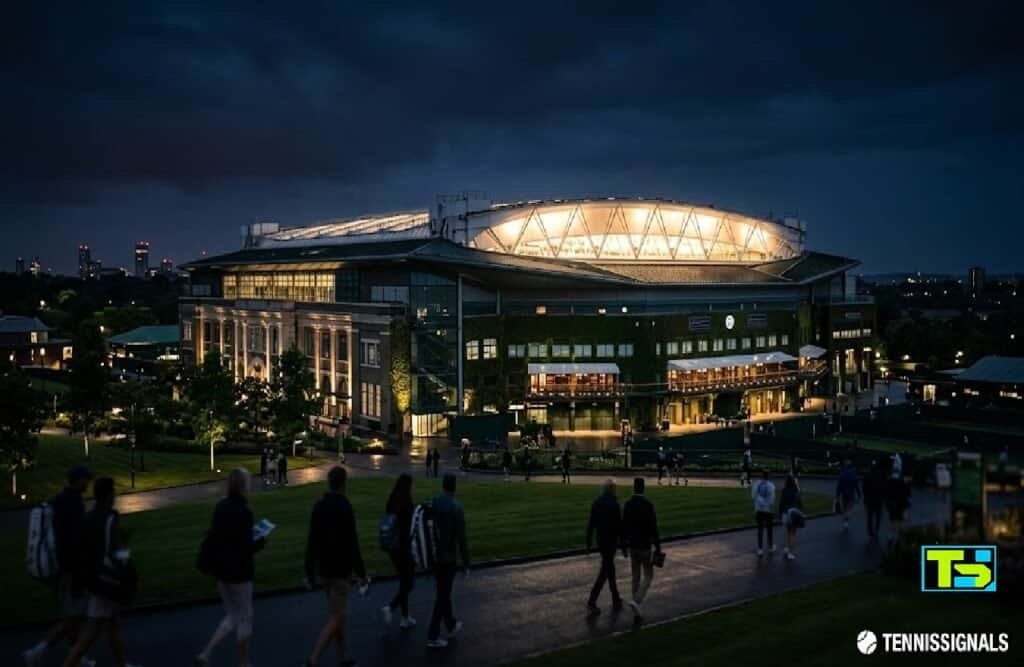
An Engineering Marvel: How and When Do the Roofs Close?
For decades, Wimbledon was a victim of unpredictable London weather, until Centre Court received a retractable roof in 2009 (Court No. 1 followed suit in 2019). However, closing the roof is not as simple as pressing a button.
Closing the translucent fabric roof itself takes about 10 minutes. So why does a rain delay often last up to 30 minutes? The problem is humidity. As soon as the roof is closed, the grass begins to “breathe” and release moisture, making the surface extremely slippery and dangerous for the players. Massive air-conditioning units must run for 20 to 30 minutes to extract the moisture and stabilize the microclimate inside the stadium before players can safely resume the match.
The tournament’s golden rule is: if a match starts under a closed roof (or the roof is closed during the match), it must remain closed for the entire duration of that specific match, even if the sun comes out.
The Wimbledon Curfew: Why Does Everything Stop at 11 PM?
You are watching an incredible five-set thriller, the tension is at its peak, the clock strikes 11:00 PM local time, and suddenly – the umpire suspends the match, and the players pack their bags and head to the locker room. Why?
The answer lies in a strict agreement between Wimbledon and the local Merton Council. This so-called “curfew” was introduced in 2009 when the first roof and floodlights were installed. The rule exists for two key reasons:
- Respect for local residents: Wimbledon is located in a quiet, residential neighborhood. The noise of thousands of fans leaving the stadium late at night would heavily disrupt the sleep of local residents.
- Public transport: London’s transport network (especially the Southfields and Wimbledon Tube stations) is not designed to safely handle the sudden influx of tens of thousands of people in the early hours of the morning. To ensure everyone gets home safely, play must conclude by 11 PM at the latest.
Behind the pristine white uniforms and beautiful flowers, Wimbledon is a machine that relies on strict rules. Whether you are queuing all night, watching a monumental roof close above your head, or leaving the stadium frustrated because a match was suspended exactly at eleven o’clock, these are the details that make Wimbledon a truly unique tournament.
Looking for more stories from London, match schedules, and the latest tennis analysis? Return to our Wimbledon 2026 – The Ultimate Guide and stay up to date with every detail of the most prestigious Grand Slam!