The specific microclimate conditions in the Spanish capital create an environment that differs significantly from other clay-court tournaments. Situated at a high altitude, Madrid offers thinner air that provides less resistance to the ball, favoring players with powerful serves and an aggressive baseline approach.
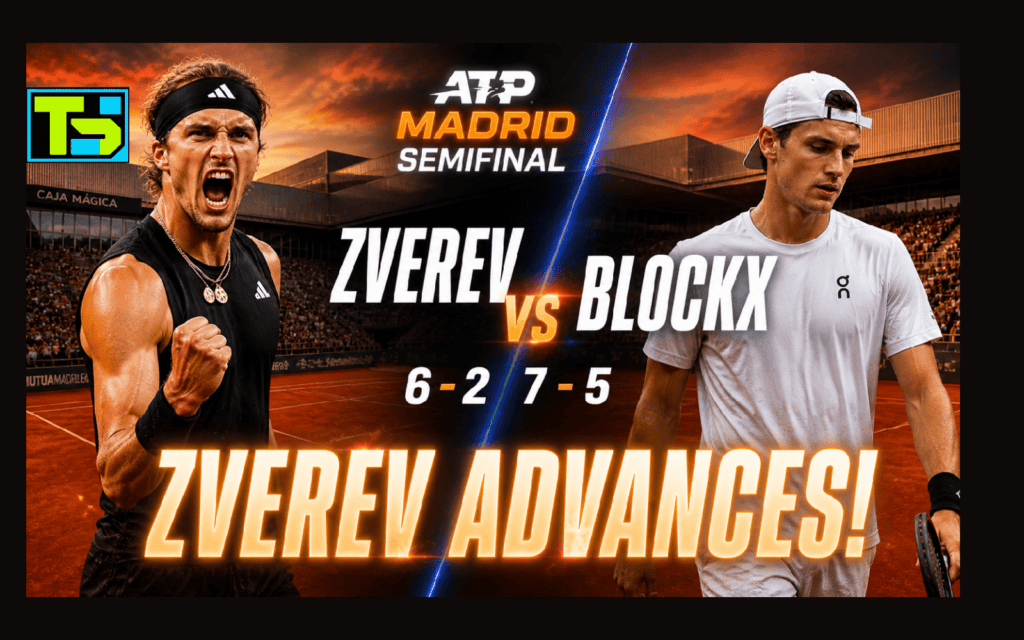
These conditions were the perfect stage for the second semifinal of the 2026 Mutua Madrid Open, which brought a completely different narrative and emotional charge compared to the first match. Experience and youth, the pressure of expectations, and the absolute freedom of playing met on the court: experienced two-time Madrid champion Alexander Zverev, and a player with zero respect for the tennis establishment, Alexander Blockx.
Alexander Blockx: Shaping a Modern Tennis Sensation
The trajectory of 21-year-old Alexander Blockx at the Mutua Madrid Open represents one of those rare, almost cinematic stories. He arrived in Madrid as the 69th player in the world. His primary goal was to play in the qualifiers, but a series of late withdrawals opened up a spot for him in the main draw at the last minute.
Taking advantage of the high-altitude conditions that accelerated his flat, penetrating baseline shots, Blockx began stringing together victories. He created his first major sensation by knocking out the world number five, Felix Auger-Aliassime, and then Francisco Cerundolo.
The climax of his Madrid fairytale happened in the quarterfinals against Casper Ruud, the defending champion. Blockx demonstrated exceptional mental stability and tactical astuteness, completely neutralizing Ruud’s heavy topspin forehand, becoming only the second player born in 2005 (or later) to reach a Masters 1000 semifinal.
The Revival of Alexander Zverev
Alexander Zverev, the tournament’s second seed and a two-time Madrid winner, entered the match carrying a heavy psychological burden on his shoulders. Before this encounter, the German had lost an incredible six consecutive semifinal matches on the ATP Tour (a total of 9 out of his last 10 semifinals).
The path to the Madrid semifinal served as a sort of therapy for Zverev. A lesson taught in the quarterfinals against Flavio Cobolli (6-1, 6-4) instilled much-needed confidence in him ahead of the clash with the player who was by far the biggest story of the entire tournament.
The Second Semifinal: Tactical Deconstruction of the Zverev vs Blockx Clash
When Alexander Zverev and Alexander Blockx stepped onto the Manolo Santana court, there was a fear that the young Belgian’s inexperience might prevail. Zverev, shaking off his own demons from previous semifinals, played a tactically flawless and fiercely aggressive match, winning 6-2, 7-5 after 1 hour and 37 minutes.
Reliance on the Serve: Flawless Execution by the German
From the very beginning, Zverev’s game was built on the solid foundation of an infallible serve, which is confirmed by the statistics.
| Match Statistics | Alexander Blockx | Alexander Zverev (2) |
|---|---|---|
| Aces / Double Faults | 6 / 2 | 6 / 2 |
| 1st Serve Percentage | 60% | 77% |
| 1st Serve Points Won | 72% (36/50) | 85% (34/40) |
| 2nd Serve Points Won | 32% (11/34) | 67% (8/12) |
| Break Points Saved | 11/14 (79%) | 0/0 (Not faced) |
| 1st Serve Return Points Won | 15% (6/40) | 28% (14/50) |
| 2nd Serve Return Points Won | 33% (4/12) | 68% (23/34) |
| Total Return Points Won | 19% (10/52) | 44% (37/84) |
| Winners / Unforced Errors | 18 / 18 | 35 / 15 |
| Net Points Won | 80% (8/10) | 89% (16/18) |
| Total Points Won | 42% (57/136) | 58% (79/136) |
Zverev played the entire match without facing a single break point (0/0). With a high first-serve percentage of 77%, Zverev won 85% of points, leaving Blockx with meager crumbs of opportunities on the return. Throughout the entire match, Zverev lost only 10 points on his own serve.
Aggressiveness, Return Pressure, and Breaking the Belgian Wall
The first set was a one-way street. Zverev established authority in the very first game of the match with a deep, aggressive down-the-line return that earned him a break. Under pressure, the young Belgian faltered once more in the fifth game of the first set, after which Zverev secured the set 6-2 in just 41 minutes.
However, the second set offered a completely different picture. Blockx engaged in an equal baseline battle. His resistance was most evident in his incredible ability to save break points – he managed to save 11 out of 14 (a 79% success rate).
The turning point and the resolution of the match unfolded at 5-5 in the second set. Blockx again ran into trouble on his serve and faced 0-40. Zverev played a defensive return, after which the ball caught the top of the net (“lucky net cord”) and dropped into Blockx’s court, finally breaking the Belgian’s resistance. In the next game, the German served securely and confirmed his spot in his fourth Madrid final on his first match point.
Tactical Macro-Trends and the Evolution of Tennis on High-Altitude Clay
These two semifinal matches provide us with valuable insights into the tactical evolution of modern men’s tennis in Madrid:
- Dominance of the “serve-plus-one” strategy: The fact that the winners of both semifinal matches (Sinner and Zverev) did not face a single break point testifies to the extreme efficiency of their serves in Madrid’s thinner air.
- Exploitation of the second serve in young players: Rising young stars Arthur Fils and Alexander Blockx achieved modest 45% and a very low 32% win rate on their second serves, respectively.
- Renaissance of net play: Sinner’s flawless 7/7 and Zverev’s impressive 16/18 at the net demonstrate a clear tactical decision by elite players to shorten points.
Analytical Projection of the Final: The Clash of Sinner and Zverev
The final in Madrid between Sinner and Zverev will not just be an ordinary battle for 1000 points and a prestigious trophy; it will be a clash of incredible forms and specific adaptations to Madrid’s conditions.
Sinner enters this final as the clear favorite (H2H is 9-4 for Sinner, with 8 consecutive wins). However, clay traditionally represents Zverev’s strongest weapon. To win in Madrid, Zverev must maintain a first-serve percentage above 75% to keep Sinner away from the baseline and avoid prolonged rallies where the Italian “wall” inevitably finds a way to force an error.
Related: A reminder that in the first semifinal, Jannik Sinner made tennis history with a fantastic victory over Arthur Fils. 👉 Read the complete tactical analysis of that duel and an overview of Sinner’s records
For all the latest results, the complete schedule, and tournament updates,👉 visit our main report.