
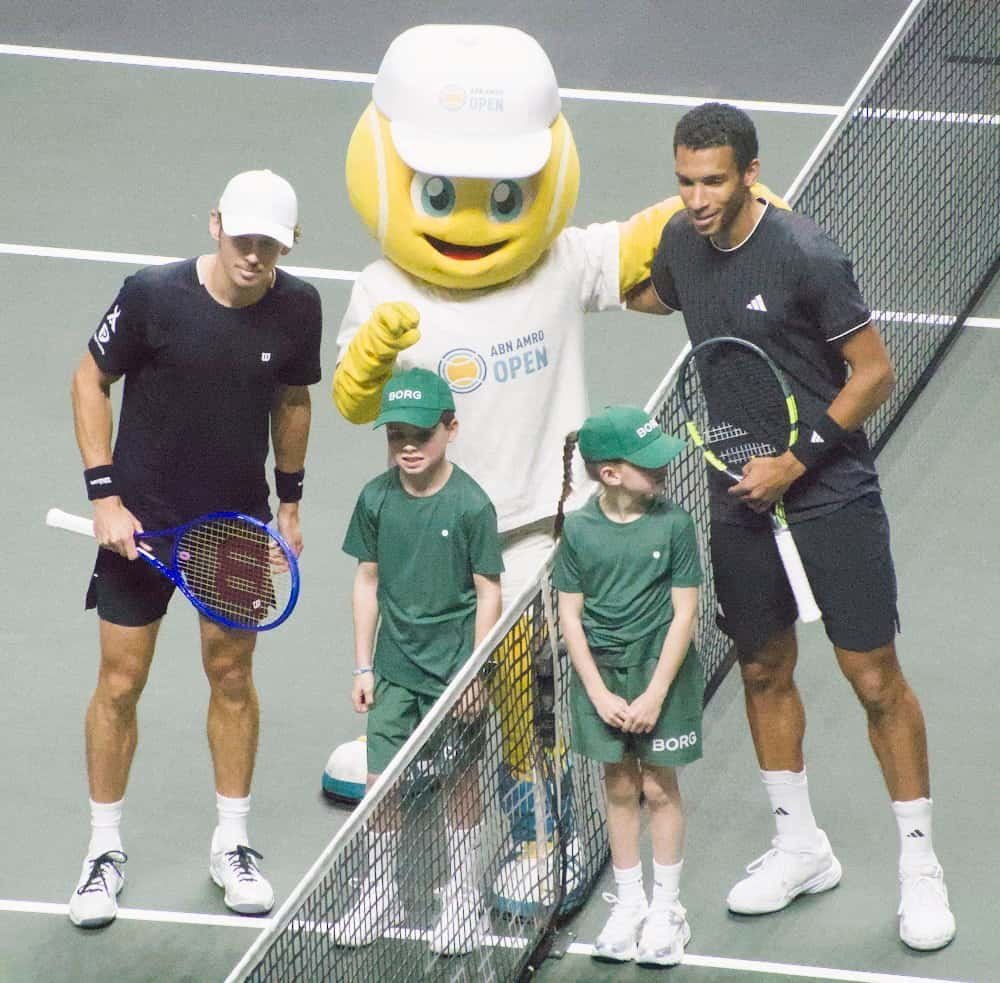
Alex De Minaur captured the 2026 Rotterdam ATP 500 title with a 6–3, 6–2 victory over Felix Auger-Aliassime in a final that was less about brilliance and more about structural superiority.
The scoreline reflects control.
The numbers explain why.
First Set: Scoreboard Close, Control Clear
At first glance, the opening set suggested balance. Felix actually won 82% of points behind his first serve (18/22) in the set. On paper, that is elite-level serving.
But the match was not decided on first serve.
It was decided on second serve.
De Minaur won 70% of return points on Felix’s second delivery (16/23) — an extraordinary number at ATP 500 level. Every time the rally extended beyond the serve, the Australian immediately neutralized the point.
The decisive break came midway through the set after sustained pressure in longer exchanges. From that moment on:
- De Minaur did not face a single break point in the entire match.
- He protected all nine of his service games (9/9, 100%).
- He won 59% of total points across the match.
Even before the set ended 6–3, the control pattern was established.
Second Set: The Turning Point at 2–2
The second set remained level through four games.
Then the match shifted.
At 2–2, Auger-Aliassime’s service game unraveled. His first-serve percentage dropped to 49% overall in the match, and under scoreboard pressure his second serve became attackable. De Minaur broke with controlled baseline depth rather than aggression.
Shortly afterward, Felix requested a medical timeout and briefly left the court. The reason was not disclosed.
However, statistically, the timeout did not change the trajectory.
From 2–2 onward:
- De Minaur won 9 of the final 10 points.
- Felix failed to generate a single break opportunity.
- The Canadian won only 41% of total match points (39/96).
The match ended with De Minaur holding comfortably at 6–2, sealing the title without ever facing scoreboard danger.
The Decisive Layer: Second Serve Exposure
Felix’s career averages:
- 50% second-serve points won
- 84% service games held
- 67% total service points won
In this final:
- 30% second-serve points won (7/23)
- 63% service games held (5/8)
- 56% service points won
That drop is not marginal — it is structural.
De Minaur, meanwhile, performed above his career return baseline:
- Career 2nd serve return points won: 53%
- In this final: 70%
This explains the imbalance more than any narrative about momentum or injury.
The Australian built the match around sustained pressure on the second serve, and the statistical spike confirms it.
Error Profile and Rally Pattern
The final featured:
- 18 total winners (10 De Minaur, 8 Felix)
- 44 unforced errors (26 Felix, 18 De Minaur)
This was not a shot-making exhibition.
It was a containment match.
De Minaur extended exchanges, redirected pace, and avoided risk. Felix, forced into baseline patience, leaked errors when attempting to shorten rallies.
Net play reflected control rather than desperation:
- De Minaur won 78% of net points (7/9)
- Felix won 83% (5/6)
But the volume tells the story: this was primarily a baseline contest decided by depth and discipline.
Service Control: The Silent Decider
De Minaur won:
- 73% of service points (37/51)
- 65% of second-serve points (11/17)
- 100% of his service games (9/9)
He never faced a break point.
In a final between two top seeds, that detail alone defines psychological dominance. Felix never had scoreboard leverage.
When a player is never allowed to threaten on return, the match becomes structurally tilted.
Momentum Snapshot
Key stretch of the match:
- From 2–2 in the second set, De Minaur captured 4 consecutive games.
- Felix won only 1 of the final 10 points.
- De Minaur closed the match winning 7 of the last 9 games overall.
The medical timeout offered a pause.
It did not offer recovery.
Tactical Blueprint
De Minaur’s winning formula:
- High percentage first serve (67%)
- Immediate pressure on second serve
- Extended rallies to backhand corner
- Minimal unforced error profile
- Depth over aggression
- Zero scoreboard panic
Rather than overpowering Felix, he out-structured him.
This was a final won through pattern discipline, not shot-making fireworks.
Contextual Significance
Auger-Aliassime entered the final with a stronger raw serve profile and historically higher hold percentage. But on indoor hard courts, second serve vulnerability under pressure can be magnified.
De Minaur exploited precisely that variable.
The match may not be remembered for drama, but tactically it offers a clear case study: sustained second-serve pressure at ATP 500 level can dismantle even elite service profiles.
Conclusion
This was not a spectacular final.
It was a precise one.
Alex De Minaur did not overwhelm with power — he dismantled with structure.
By attacking the second serve, maintaining baseline depth, and protecting every service game, he removed uncertainty from the equation and secured the Rotterdam ATP 500 title with clarity rather than chaos.
In high-level tennis, control often matters more than brilliance.
In Rotterdam, control decided everything.
Prize money details and earnings breakdown are available in our dedicated Rotterdam ATP 500 Prize Money post.
A full breakdown of the original bracket and projected clashes is available in our Rotterdam ATP 500 first-round draw report.