The final of the 2026 ATP Masters 1000 in Madrid is far more than a simple title match; it is a clash between the most dominant force in tennis today and a player who finds his peak form in the specific conditions of the Spanish capital. Jannik Sinner, the world number one, enters this match with the ambition to cement his historic position, while Alexander Zverev, a two-time champion of this tournament, seeks a way to break a losing streak that threatens to become a psychological barrier in his career. This analysis reconstructs every element of the upcoming final, from technical parameters and altitude impact to the deep psychological dynamics of a rivalry defining the modern era of tennis.
Historical Context and Significance for the 2026 Season
The 2026 season has become the stage for the incredible rise of Jannik Sinner, who had already secured titles in Indian Wells, Miami, and Monte Carlo before arriving in Madrid. His performance in Madrid marks an attempt to win a fifth consecutive Masters 1000 title—a streak beginning in Paris at the end of 2025. Achieving this would place him ahead of the “Big Three” in terms of consecutive dominance at tournaments of this category.
By reaching this final at age 24, Sinner has become the youngest player in history to reach the final match at all nine Masters 1000 series tournaments. This data speaks not only to his talent but also to his incredible adaptability across different surfaces and conditions. His streak of 27 consecutive victories at the Masters level testifies to a mental and physical superiority rarely seen in professional sports.
On the other hand, Alexander Zverev arrives in Madrid as a player who feels at home at “Caja Magica.” His titles from 2018 and 2021, as well as the 2022 final, confirm that Madrid’s conditions suit him perfectly. However, Zverev faces a problem that AI analytics and statistical models cannot easily solve: he has lost the last eight matches against Sinner. For the German, this final is not just an opportunity for an eighth Masters title, but a necessary validation that he can still compete with the absolute leader of the ATP rankings.
Path to the Final: Analysis of Form and Performance
Both players’ paths to the final were marked by dominance, but also by moments revealing their current tactical priorities. Sinner routinely defeated Arthur Fils in the semifinals, while Zverev had to show high levels of concentration against the tournament’s surprise, Alexander Blockx.
Jannik Sinner: Clinical Precision on the Path to History
Sinner’s performance in Madrid was characterized by minimal energy expenditure. Except for one set dropped early against Benjamin Bonzi, the Italian remained untouchable. His 6-2, 6-4 victory over Fils in the semifinals was a demonstration of force, where Sinner controlled the baseline and used drop shots to disrupt the Frenchman’s rhythm.
| Criterion | Jannik Sinner (Path to Final) | Significance for the Final |
|---|---|---|
| Sets Dropped | 1 (vs. Bonzi) | High level of freshness |
| 1st Serve Points Won | 87.5% (in SF) | Key to neutralizing Zverev |
| Break Points Saved | 100% in SF and QF | Mental toughness in clutch moments |
| Career Wins | 350 (achieved in SF) | Reached in only 436 matches |
Alexander Zverev: The Return of the King of Madrid Clay
Zverev showed why many consider him one of the best players on fast clay. His serve was his main weapon, and his 6-2, 7-5 semifinal victory over Alexander Blockx proved he can withstand pressure from younger players. Zverev won 85% of his first-serve points in that match—a stat that should worry Sinner’s team if maintained on Sunday.
| Criterion | Alexander Zverev (Path to Final) | Significance for the Final |
|---|---|---|
| Aces (Tournament Total) | Over 45 | Serve as the first line of defense |
| Service Games Won % | 90% | Ability to keep pressure on the opponent |
| Experience in Madrid | 4th Final | Knowledge of micro-location conditions |
| Form vs. Top 10 | 1-0 (Win over Cobolli/Medvedev) | Returning confidence against the elite |
Head-to-Head Analysis and Tactical Reconstruction
Analyzing the H2H history between Sinner and Zverev reveals a clear shift. While Zverev dominated the early stages of their rivalry, Sinner took complete control from late 2023. The current ratio is 9-4 in favor of Sinner, but even more striking is that the Italian has won the last eight meetings, five of which ended in straight sets.
Dynamics in the 2026 Season
This final will be their fourth meeting in 2026, with the previous three occurring in the semifinals of Indian Wells, Miami, and Monte Carlo. Sinner won all three without dropping a set.
- Monte Carlo (SF, Clay): Sinner wins 6-1, 6-4. Zverev failed to generate a single break point.
- Miami (SF, Hard): Sinner wins 6-3, 7-6. Zverev provided more resistance, but Sinner was ice-cold in the tie-break.
- Indian Wells (SF, Hard): Sinner wins 6-2, 6-4. The key difference was the second serve, where Zverev won only 28% of points.
| Category | Jannik Sinner | Alexander Zverev | Advantage |
|---|---|---|---|
| Total H2H | 9 | 4 | Sinner |
| On Clay | 2 | 1 | Sinner |
| Masters 1000 Level | 5 | 1 | Sinner |
| Last 8 Matches | 8 | 0 | Sinner |
| Sets Won (Total) | 23 (63.9%) | 13 (36.1%) | Sinner |
The Impact of Altitude and Atmospheric Conditions in Madrid
One of the most important factors in this final will be Madrid’s altitude (approx. 650 meters). Unlike Rome or Monte Carlo, where the air is denser and the ball slower, tennis in Madrid is played in conditions resembling indoor hard courts.
Ball Flight Physics and Drag Force
At higher altitudes, air density is lower, reducing air resistance or “drag force” on the ball. The result is a ball that travels faster with a shallower trajectory. This directly benefits flat hitters like Sinner and big servers like Zverev.
Analysis shows that Madrid suits Sinner’s game because he takes the ball early. His flat shots become even deadlier, while opponents have less time to set up their defense. Conversely, Zverev “owns” the court in Madrid because his serve gains speed and bounce, and his backhand remains stable under the pressure of faster balls.
Technical and Tactical Analysis: Where Will the Match Be Decided?
For Zverev to beat Sinner, he must break the pattern repeated in their meetings. Sinner currently dictates the tempo while Zverev reacts—a dynamic where the Italian excels.
The Battle of the 1st and 2nd Strike
In Madrid, over 70% of points end within the first four shots. Sinner’s advantage lies in transition. He is the best in the world at turning a neutral situation into an offensive one with a single strike. Zverev must rely on his first-serve percentage; if it falls below 65%, Sinner will have too many opportunities to attack the second serve.
| Game Element | Sinner Advantage | Zverev Advantage | Dynamic Description |
|---|---|---|---|
| 1st Serve | X | Zverev’s height/power are key in Madrid. | |
| 2nd Serve | X | Sinner’s attack on the 2nd serve is decisive. | |
| Return | X | Sinner returns balls others would just watch. | |
| Movement | X | Sinner’s agility on clay is currently unmatched. | |
| Mental Toughness | X | Sinner has an 8-0 psychological lead. |
Betting Parameters and Market Expectations
The betting market clearly recognizes Sinner as the absolute favorite based on his unstoppable winning streak and historical dominance over Zverev.
- Sinner to win: 1.16 1/6 (-610).
- Zverev to win: 5.00 4/1 (+430).
- Sinner 2-0: 1.61 8/13 (-170) — Most likely outcome.
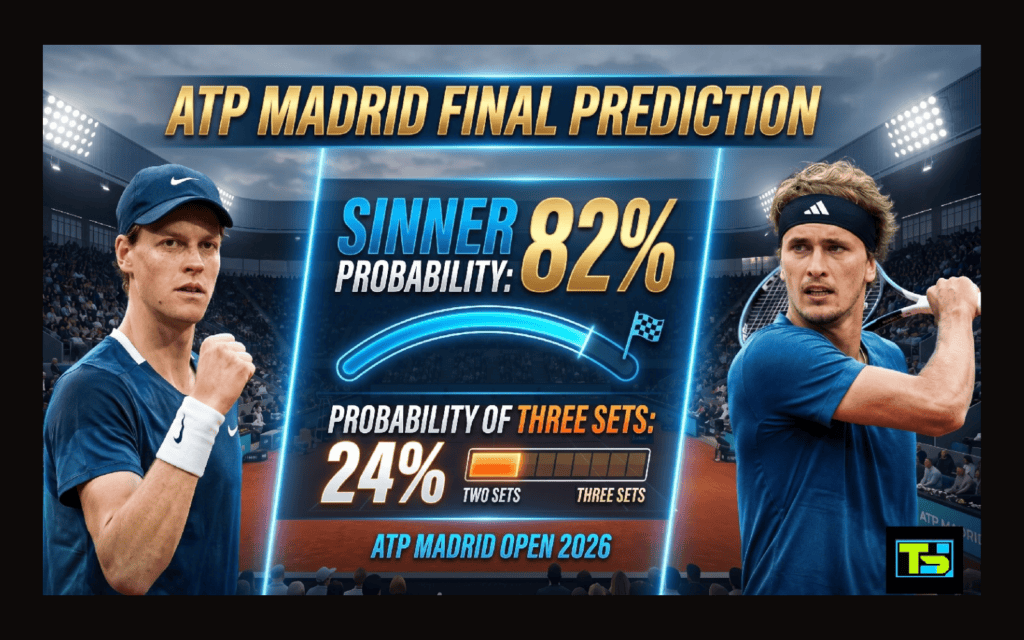
- Probability of Sinner winning: 82%.
- Probability of Three Sets: 24%.
Psychological Profile and Player Quotes
Zverev was remarkably realistic in post-semifinal statements, admitting Sinner is the best in the world and that tennis looks “very easy” for him. This rhetoric is a double-edged sword; it removes pressure but may indicate a lack of true belief. Sinner, meanwhile, shows a level of calmness reminiscent of Björn Borg, treating the final as “just another day at the office.”
Conclusion and Final Assessment
The 2026 Madrid Open final will be a testament to whether anyone can stop Jannik Sinner right now. Every data point—from H2H ratios and second-serve efficiency to altitude adaptation—favors the Italian. While Zverev has the weapons to be competitive, Sinner’s ability to find solutions on the fly makes him the overwhelming favorite. We expect Sinner to lift his eighth Masters trophy.
Final Prediction: Jannik Sinner in straight sets (2-0).
👉 Follow all the latest results and the complete tournament schedule at our central hub: