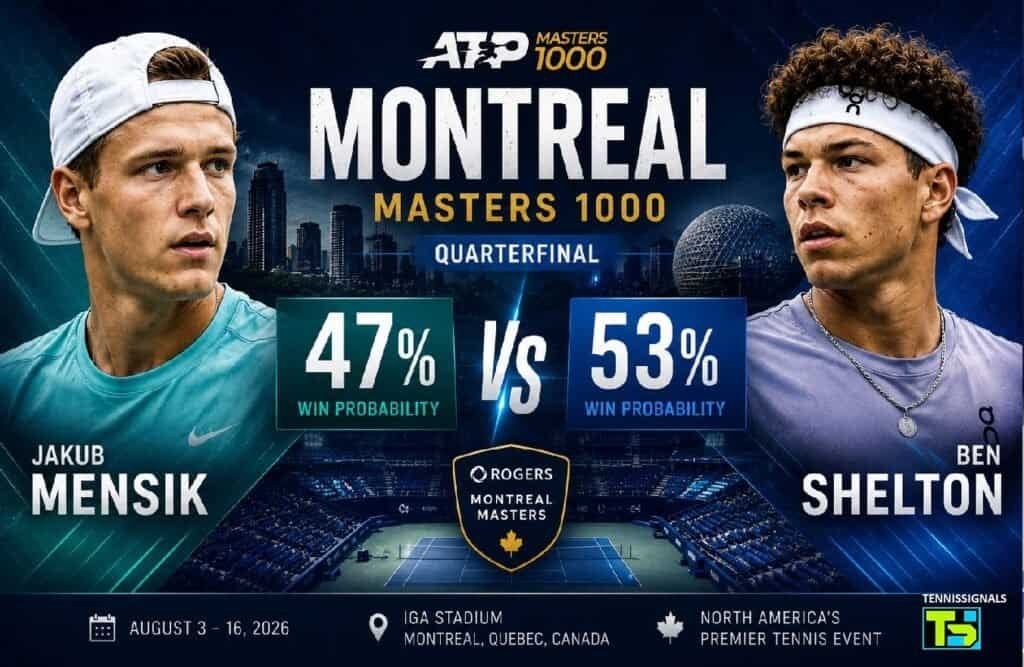
This report provides an expert analysis of the upcoming quarterfinal match at the 2026 Montreal Masters tennis tournament, focusing on head-to-head encounters, hard court form, and predicting the outcome based on tactical and statistical parameters. In accordance with the request, the analysis is concise, without compromising the depth of expert insight.
Head-to-Head Record and Previous Encounters
Previous encounters indicate a slight advantage for Jakub Mensik, who leads the overall head-to-head 2-1. Their first clash on a hard court took place at the Indian Wells tournament in 2024, where Shelton won in three sets with a score of 4-6, 6-3, 6-4. Mensik retaliated in early 2025 in Auckland, also on a fast hard court, winning after a comeback in a highly exhausting match with a score of 6-7, 6-4, 7-5. The last match they played was on clay in Madrid the same year, where the Czech tennis player dominated in two sets (6-1, 6-4), denying Shelton any chance to reach a break point. These data suggest that Mensik possesses a clear tactical formula to neutralize Shelton’s game, especially with his ability to limit the damage of the opponent’s first serve.
Form Analysis and Hard Court Performance
Analyzing their recent form on hard courts, both players enter the quarterfinal with impressive results and rely on exceptionally powerful serves. Ben Shelton, currently the tenth player in the world and defending champion in Montreal, shows a high level of confidence at this tournament. On his way to this stage, he eliminated Jenson Brooksby, Zizou Bergs, and Joao Fonseca, demonstrating elite control of his initial shot, losing his serve only three times in his first three matches.
On the other hand, the seventeenth player in the world, Jakub Mensik, has recorded highly stable performances in Montreal characterized by clinical precision in crucial moments. He sequentially defeated Jacob Fearnley, Terence Atmane, and Botic van de Zandschulp, suffering only one break in his last two matches played. His ability to maintain a high first-serve percentage ensures a smooth transition to the offensive.
Tactical Dynamics and Key Statistical Indicators
Tactically speaking, the upcoming match represents a classic clash of elite servers where break opportunities will be minimal. Shelton’s biggest vulnerability this season lies in his return game. The American tennis player wins only 13% of return games, making him statistically the weakest player in the top ten in that key segment. Given that both players rarely created break opportunities in their previous encounters, a match with few rallies is predicted, where the winner will likely be decided by nuances in tie-breaks.
| Statistical Indicator | Ben Shelton | Jakub Mensik |
|---|---|---|
| ATP Ranking | 10th | 17th |
| Head-to-Head (Overall) | 1 win | 2 wins |
| Head-to-Head (Hard Court) | 1 win | 1 win |
| Dropped Serves (Montreal 2026) | 3 in three matches | 1 in last two matches |
| Calculated Win Probability | 53.19% | 47.62% |
Outcome Prediction and Win Percentages
Taking all these parameters into account, the analytical model points to a highly unpredictable duel with a minimal margin for error. Market predictions and quantitative models slightly favor the American tennis player, giving Shelton a 53.19% chance of winning, while Mensik is attributed 47.62%.
Due to Shelton’s weaker return and Mensik’s proven psychological stability in their earlier encounters, a great battle is expected. The final prediction acknowledges a slight advantage for Ben Shelton (53%) primarily due to the pressure and experience of playing the final stages of Masters 1000 tournaments where he is defending the title, but tactical indicators suggest the match will most likely go to three sets with a high number of games played, where performance on the second serve during a tie-break will play the key role.
Internal Links & Resources
- For more expert insights on this week’s matches, explore our latest tennis predictions and betting tips.
- Make sure to stay updated with all the results, schedules, and draws at our comprehensive ATP Montreal 2026 Hub
- Take a closer look at the ATP Tour rankings and statistics to see how these players compare over the full season.