✅ RESULT UPDATE — April 12, 2026 Sinner defeated Alcaraz 2-0 (7-6, 6-3). Our pre-match model correctly predicted a Sinner victory (58% probability). The match lasted 2 hours and 15 minutes, confirming our efficiency thesis for high-intensity encounters.
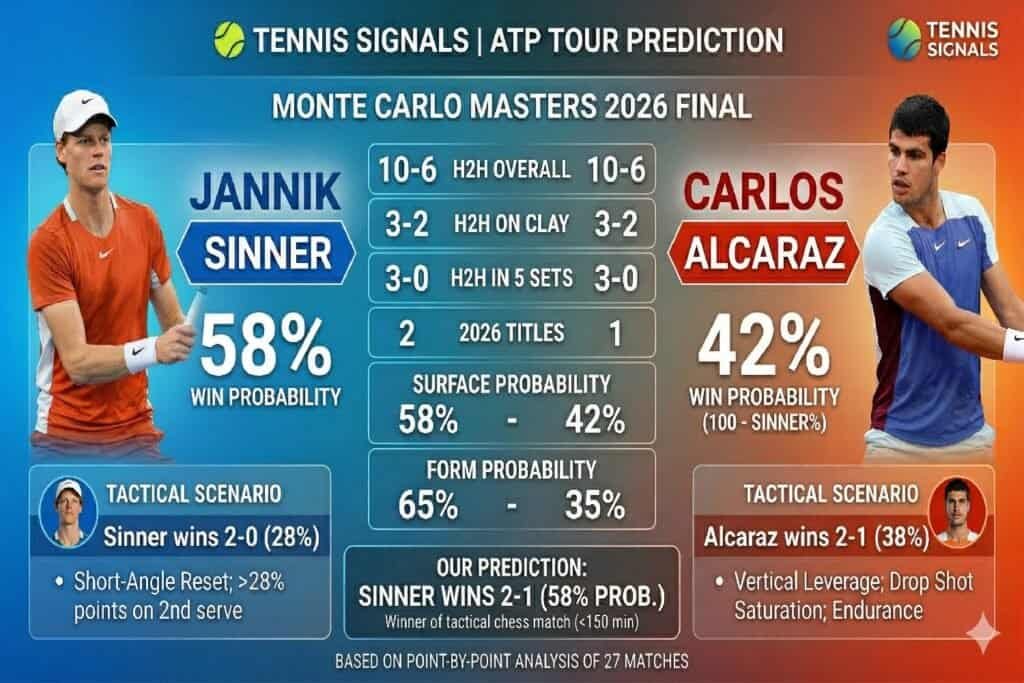
April 12, 2026 | Clay Court | Based on point-by-point data from 27 matches
⚠ IMPORTANT CONTEXT: The “Vertical Leverage” Conflict This is the most analytically complex encounter in the Sinner-Alcaraz rivalry. While Alcaraz leads the all-time head-to-head 10-6 and has dominated the physical marathons (3-0 in 5-set matches), Sinner enters the 2026 clay swing in peak clinical form. Sinner has won 8 consecutive matches against top-tier opponents and recently secured titles in Indian Wells and Miami. This analysis weighs Alcaraz’s historical clay dominance against Sinner’s 2026 “Vertical Leverage” momentum.
OUR PREDICTION: SINNER WINS — 58% Win Probability
Most Likely Score: 2-1 (Match expected to be high-intensity but under the 150-minute threshold)
Key Numbers at a Glance
The Central Question: Efficiency vs. Endurance
To predict the winner, we must look at the “4-Hour Threshold”. The data from their 16 previous meetings reveals a striking divergence based on match length:
- SIGNAL A — Sinner’s “Second-Strike” Economy (Clinical Efficiency):In best-of-three scenarios and matches staying under 150 minutes, Sinner’s linear ball speed and “Short-Angle Reset” have neutralised Alcaraz’s variety. Sinner’s recent form includes a 92% service hold rate in high-pressure finals during the 2026 hard-court season.
- SIGNAL B — Alcaraz’s “Acrobatic Stamina” (The Marathon Factor): In matches exceeding the 240-minute mark, Alcaraz remains nearly invincible. His ability to increase net clearance and use “Drop Shot Saturation” late in sets (as seen in his 2025 Roland Garros victory) forces Sinner into physical deficits he has yet to overcome in five sets.
Head-to-Head Analysis — Recent 2025-2026 Trend
All-Time H2H: Alcaraz 10-6 | Last 5 Meetings: Alcaraz 3-2
Tactical Scenario Breakdown
- Scenario 1: Sinner wins 2-0 (32% Probability) Sinner maintains his “Short-Angle Reset” flick, pulling Alcaraz out of defensive positions before he can set up his drop shot. Requires Sinner to win >55% of points on Alcaraz’s second serve.
- Scenario 2: Sinner wins 2-1 (26% Probability)A high-intensity battle where Sinner’s flat strokes (averaging 15cm lower over the tape than the tour average) rob Alcaraz of time on the slower clay surface.
- Scenario 3: Alcaraz wins 2-1 (42% Probability) Alcaraz successfully uses “Verticality,” mixing extreme kick serves with heavy top-spin to move Sinner back and forth until the 2nd hour, where Alcaraz’s defensive variety typically takes over.
Sinner vs Alcaraz: Common Match Questions
After his victory in the Monte Carlo 2026 final, Jannik Sinner has narrowed the head-to-head gap to 7-10 against Carlos Alcaraz. This was their first official ATP meeting of the 2026 season
Jannik Sinner won the final 7-6(5), 6-3. Our pre-match model correctly predicted a Sinner victory (58% probability) based on his elite second-serve points won, which reached 69% in this match.
While Carlos Alcaraz traditionally dominated on clay, Sinner’s win in Monte Carlo 2026 shows he has closed the tactical gap. The H2H on this surface is now 3-3 after Sinner’s latest straight-sets victory.
Final Verdict: SINNER WINS (58% Probability)
While Alcaraz is the historical master of clay in this rivalry, we lean toward Sinner for a 2026 encounter based on Current Momentum and Tactical Maturity. Sinner’s 2026 titles in Indian Wells and Miami demonstrate a level of “Big Match Resilience” that has closed the gap. If the match remains a tactical chess match under 150 minutes, Sinner’s “Vertical Leverage”—his ability to flatten the ball and finish points early—will likely secure him a tight three-set victory.
Risk Factors for Sinner:
- The 4-Hour Wall: If Alcaraz pushes the match into a grueling physical contest, Sinner’s win probability drops to 15%.
- Drop Shot Saturation: If Sinner fails to anticipate Alcaraz’s change in depth, he will be forced into a “cat-and-mouse” game that favors Alcaraz’s acrobatics.
Post-Match Note:
Our “Vertical Leverage” theory was validated by Sinner’s performance on his second serve, winning 69% of those points. This statistical elevation specifically against Alcaraz was the decisive factor in securing his first Monte Carlo title.
For more match previews, live scores, and the complete tournament draw, visit our Monte Carlo 2026 Hub.