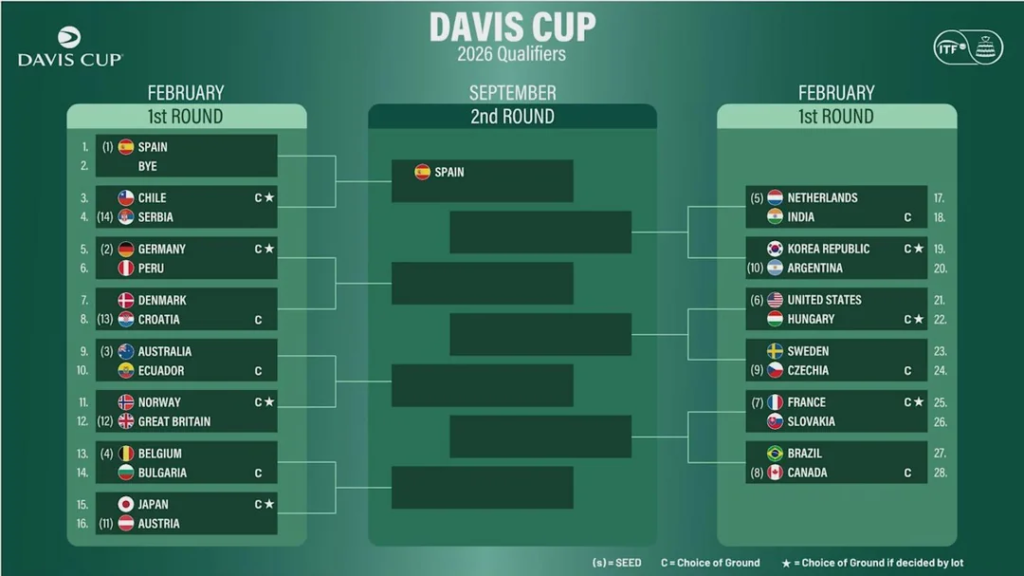
The Davis Cup 2026 qualifiers will be played from 5–8 February, as 13 nations battle in home-and-away ties for a spot in the next stage of the race towards the season-ending Final 8. With the ATP Tour shifting from the Australian swing into the early indoor and team-tennis phase, the Davis Cup 2026 qualifiers arrive at a perfect moment in the calendar.
Davis Cup 2026 qualifiers format
The 2026 Davis Cup season is built around a multi-stage format that culminates in a Final 8 event in November. The February qualifiers represent the first major step on that path, as 13 ties determine which nations move closer to the season finale.
Each qualifier tie is played over two days in a best-of-five-rubber format, with matches contested as best-of-three-set encounters. Day one typically features two singles matches, followed by a doubles match and two reverse singles on day two, giving captains several tactical options with their line-ups. Hosts choose the venue and surface, which often becomes a crucial strategic weapon in tight matchups.
The 13 winning nations from the February qualifiers advance into the next stage of qualifying later in the season, where they can secure a place in the Final 8. Italy is already guaranteed a spot in the 2026 Final 8 as host nation, while Spain receives a bye into the second qualifying round after reaching the 2025 final.
Key ties to watch in the 2026 Davis Cup qualifiers
Although every tie carries significant weight, a few stand out because of star power, surface choices and the stakes involved for traditional tennis nations. Here are some of the most compelling matchups on the 2026 Davis Cup qualifiers schedule.
Chile vs Serbia
Chile welcomes Serbia on home soil and is expected to opt for outdoor clay conditions to maximize its advantage. The South American hosts typically thrive on slower courts and enthusiastic crowds, while Serbia arrives as a seeded nation carrying the pressure of expectation.
With Serbia’s recent Davis Cup history and depth in singles and doubles, the visitors will likely start as favourites on paper. However, the combination of altitude, clay and partisan support can easily turn this into one of the most dangerous away ties of the weekend.
Norway vs Great Britain
Norway hosts Great Britain in what could be one of the highest-quality ties of the qualifiers, headlined by Casper Ruud and Jack Draper. Ruud’s clay-court pedigree and growing all‑court game make him the anchor of the Norwegian squad, while Draper has quickly become one of Britain’s most explosive left-handed threats.
Great Britain brings strong doubles tradition and depth through multiple top‑100 singles players, which often proves decisive in Davis Cup play. Norway, on the other hand, will rely heavily on Ruud delivering in both singles and possibly doubles, backed by a home crowd eager to push the team into the next phase.
Canada vs Brazil
Canada plays host to Brazil in a tie that should favour the North American team, especially if the surface is a medium-to-fast hard court. Canada’s recent success in team competitions has been built on aggressive baseline play and strong serving, a combination that generally translates well to indoor or low-bouncing conditions.
Brazil typically prefers slower clay courts, where its players can extend rallies and use heavy topspin to dictate play. If Canada can impose quicker conditions, the hosts will likely enter as clear favourites, but Davis Cup history is full of upsets when underdogs embrace the team environment.
France vs Slovakia
France entertains Slovakia at home and once again looks to leverage its deep squad and passionate crowds. The French team often has multiple options in both singles and doubles, allowing the captain to adjust pairings based on form and matchups over the two days.
Slovakia arrives as a dangerous opponent capable of pushing higher-ranked teams, especially if its top players find quick rhythm indoors. Still, the combination of home advantage, experience and historical Davis Cup pedigree keeps France among the favourites to progress from this tie.
Croatia vs Denmark
Croatia’s home tie against Denmark stands out as another potential thriller, particularly given Croatia’s proud Davis Cup record and doubles strength. Croatian teams traditionally rely on big serving and strong net play, which become even more effective on faster indoor courts.
Denmark travels as the underdog but has shown in recent seasons that it can trouble bigger nations when its top players click at the same time. If the tie remains close heading into the final day, pressure could shift sharply onto the hosts, turning this into one of the weekend’s most unpredictable battles.
How the qualifiers fit into the 2026 tennis season
The Davis Cup 2026 qualifiers arrive just after the Australian Open and during the early portion of the indoor and hard‑court swing, providing a change of rhythm from regular ATP events. Many players use this week to represent their countries before shifting back to the tour for ATP 250 and 500 events in Montpellier, Rotterdam, Dallas and beyond.
For fans, the February qualifiers offer a first look at how national teams are shaping up in an important year that will culminate with the Final 8 in November. With home crowds, tactical surface choices and best‑of‑five ties, the Davis Cup 2026 qualifiers promise a weekend of high‑stakes tennis that feels very different from standard week‑to‑week tour action.
After the Davis Cup weekend, the ATP Tour returns to the European indoor swing, with the ABN AMRO Open in Rotterdam (9–15 February 2026) next on the calendar—see our full preview here.